Lecce, Italy: essential travel guide to one of the most beautiful cities in Southern Italy
All you need to know about a planning a trip to Lecce, Puglia. The best things to see and do, where to stay, best restaurants in Lecce and travel tips to enjoy this stunning art city in Puglia [Updated 2026].
Lecce is one of the most beautiful cities in the South of Italy.
Located in the heart of Puglia, away from the coast and beaches that make the region famous, Lecce doesn’t always appear on Puglia itineraries, yet is is a jewel of a place and a city that is guaranteed to capture the heart of many, and of art lovers in particular.
An ancient city dating from pre-Roman times, Lecce has stunning Roman ruins, an important historic ghetto and stunning baroque churches of such beautify and significance, they got Lecce the nickname ‘Florence of the South’!
I love Lecce.
I have visited with my parents and kids (three generations of us on the go! If you’re going with children, have a look also at our tips here, about Lecce with kids) and stayed several days and we have all found it beautiful, rewarding and very much worth the visit.
During our trip, we used the tips from a local friend of our family to make the most of our time and took a local walking tour so we could learn about the history and the city. Today, I share all my tips to visit Lecce and my best recommendations based on our experience and local tips!
I hope this essential travel guide inspires you and help you plan your stay. Safe travel planning!
Please note: this post contains affiliate links. Should you make a purchase, we might make a small commission.
How long to stay in Lecce
I recommend you stay in Lecce a minimum of two days to see the city center. Longer if you decide to use it as a base to explore Salento.
The best things to see in Lecce – sightseeing ideas as you stroll around the center
The best things to see in Lecce are in the town’s historic center.
While you don’t need an itinerary to explore it, I have written this list following the geography of the city, so that you can effectively use this list to make your own walking tour of Lecce, should you like to visit in your own time.
You’ll find our recommended guided walking tour below, in the ‘tours and activities’ paragraph.
Porta Rudiae
Porta Rudie is one of the ancient gates to Lecce and still nowadays one of the access gates to the historic center.
The gate seems to have been in this position since pre-Roman time, yet it acquired it current Baroque appearance as late as the XVIII century, when it went through extensive refurbishment.
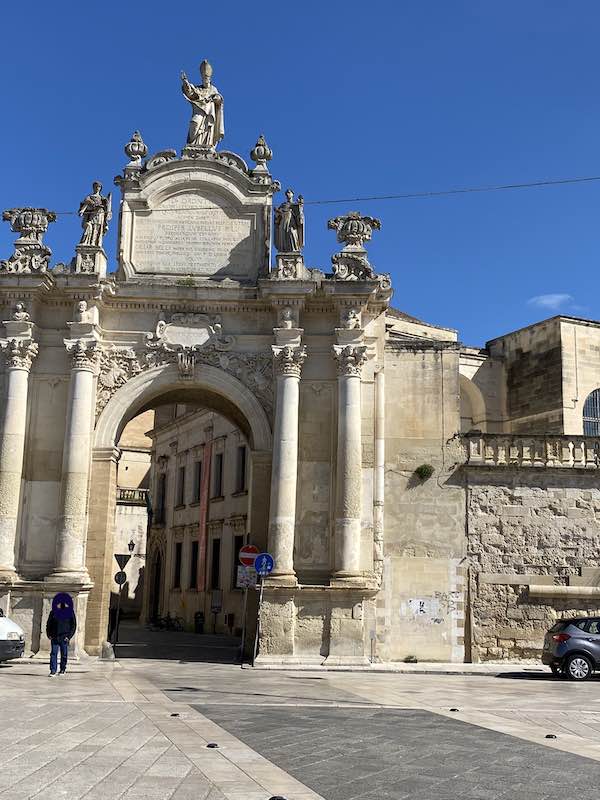
The gate is decorated with images of the patron saints protecting Lecce, namely St Oronzo, St Irene and St Domenico.
Porta Rudiaes is one of the four historic gates of ancient Lecce and the one you are likely to enter the city from, if coming from the station for instance.
The others are Porta Napoli, Porta San Biagio and Porta San Martino: the first two still exist, while Porta San Martino has been taken down in the early XIX century because, the story goes: ‘it beauty didn’t compare with that of the others’!
Via Libertini and Via Palmieri
Via Palmieri and Via Libertini are the main thoroughfare through Lecce and the two main streets you’ll find yourself walking on while cisiting the ancient city.
The streets are largely closed to traffic and beautiful: many of the city’s churches and more significant buildings overlook it and they have a plethora of cafes, restaurants and shop that allow for pleasant stops.
Piazza Duomo and Santa Maria Assunta
Lecce has many stunning churches worth seeing.
The churches are examples of the Apulian Baroque style that is unique to this part of Italy and have elaborate facades carved into the local cream colored stone and elaborate interiors with flourished decor and the visual abundance typical of the Baroque aesthetic.
I recommend you enter any you happen to pass by but there are a couple that I believe you should intentionally seek out: Lecce’s Duomo and the Church of Santa Croce (see below).
Santa Maria Assunta is the Duomo of Lecce and overlooks a stunning, large piazza, one of the most beautiful in town.

The church dates to the XV century, it has a beautiful baroque facade and elaborate altars worth seeing, especially the Altar to St Oronzo for its incredible marbles and Altare dell’Immacolata and its elaborate carvings.
The church also has a tall bell tower which is often open to visitors: climbing up offers great views over the city!
As you get to the duomo, give yourself time to admire the piazza it overlooks: Piazza Duomo. A stunning example of Baroque urban architecture and one of the most beautiful spots in Lecce.
Need to know: to help preserving the Baroque heritage of Lecce, access to the most significant churches is ticketed for visitors. You can get tickets there and then: the combined one covering all the main churches is a worthy investment. You can find info here.

Piazza Sant’Oronzo, the Roman Amphitheater, Lecce’s mosaic
As you keep walking along Lecce’s main street you get to Piazza Sant’Oronzo, one of the most significant and and impressive in the city.
The piazza takes its name from Lecce’s Patron saint and has several attractions worth noticing.
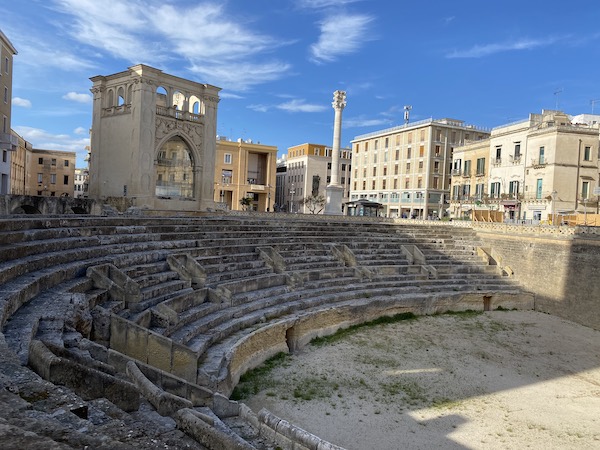
Ancient Roman amphitheater.
The most important is the Roman Amphiteater, the ruins of which are still well visible.
The Roman amphiteater of Lecce dates back to the I century AD and just like other structures of the same type, was a space used for hunting shows (venationes) and possibly local gladiator games.
Archaeologists believe it was able to host 12,000 – 14,000 spectators.
Unfortunately over time the city developed in such a way that part of the theater was demolished in medieval times and absorbed as part of the newer medieval town, so it is not only partially visible.
It is still however a stunning site and an easy one to see, since you can get a good glimpse to its structure even just walking along it.
Lecce’s mosaic
Beside the amphitheater you find large floor mosaic with a depiction of the wold and oak leaves, the symbols of the city of Lecce.
The mosaic dates to the XIX century. Good to know: while the mosaic is not cordoned off, our guide warned us to not walk on it, so we are passing this info along!

St Oronzo’s Column and Seat
On Piazza Sant’Oronzo you can also admire the Column devoted to Sant’Oronzo and the so called ‘Seat’ one of the most beautiful Renaissance landmarks in Lecce.
Santa Croce church
the Church of Santa Croce is one of the most beautiful in Lecce and one that is likely to leave with your jaw dropped open in wonder as it has a facade so delicately and elaborately carved, it looks as it it was made of lace, rather than stone!
This is the one church I recommend you consider taking a tour of: enjoying its beauty is easy even without a guide, but the carvings have elaborate meaning, symbols and historical significance that add a lot to the enjoyment of the visit and offer the opportunity to dig deeper into the history of Lecce.

We learned about it during a guided walking tour, which started just in front.
Need to know: to help preserving the Baroque heritage of Lecce, access to the most significant churches is ticketed for visitors. The combined one covering all the main churches is a worthy investment. You can find info here.
Jewish Museum of Lecce
Lecce was home to a thriving Jewish community and the Jewish Museum now host memories of their story and also as a space to exhibit and showcase contemporary art by artists from all walks of life working with local materials or anyway making art with connections to Lecce’s unique heritage.
Top tip! if you are interested in the Jewish heritage in Lecce, I recommend you take this walking tour of the city which also includes the museum and gives an excellent overview of Lecce’s history.
Roman Theater
One of my favorite spots in Lecce is ancient Roman Theater.
Less grand than the above mentioned amphitheater, the theater is now in a small, hidden square and it is surrounded by buildings, so much so that you don’t really know it is there until you get right beside it!
The theater dates from the I century AD and it is a romantic, historically significant spot to see in Lecce, worth seeking out while exploring.
Admire Lecce’s Papier Mache’ art (cartapesta di Lecce)
Lecce is home to a unique craft: paper mache’ (cartapesta)!
As you walk around the city, you will find several artisan shops showcasing this ancient art and i recommend you stop and observed their artwork as it is impressive and significant.
The paper mache’ craft in Lecce seems to date back to the XVII and XVIII century.
At this time, many churches were built in the city but there was a significant scarcity of materials to decorate them. Local artisans therefore had to come up with a solution: use local, poor materials to create the statues they couldn’t otherwise get!

The results are so precise and astonishing, you’d never know. There are several ways to enjoy Lecce’s cartapesta art: you can visit the Museum or even just peek into the many local shops with artisans still at work.
You’ll see them as you walk along Lecce’s main streets and beside the duomo.
The best things to do in Lecce: Best Tours and activities
Lecce is a small town but it has some lovely activities to keep you busy.
Take a tour of the city center on foot / by bike / by Rickshaw
Lecce is a city full of history and taken a tour to getting to know it is well worth it.
Great ones we enjoyed are on foot, by rickshaw and by bike – all special in different ways! We walking one was the one with the most facts, stops and history details; the bike one is fun if you like a faster pace and covering more grounds; the rickshaw one is perfect if you cannot or do not want to walk pretty much at all. So, there is a good one for all needs!
Take a cooking class
Lecce and Puglia in general has delicious food and a strong food tradition and there is no better way to immerse yourself in it than by taking a class!
In Lecce, we found two nice ones: one on pasta and tiramisu (a very Italian offering) and the other one even more local, as it teaches you to make orecchiette, which is the local pasta specialty!
Take a food tour
Another great way to immerse yourself in local food, but without having to cook, is taking a Lecce walking food tour. The tour focuses on local specialties (the pasticciotto is out of this world!) and a fun way to stroll around the city with a guide while tasting delicious morsels of local specialties. This is a great way to get an overview of what Lecce has to offer if you have limited time in the city or also the opposite: a way to have a shortlist of places should you have serval days here!
Take a paper mache’ class
If you like hands on activities and getting to chat with local artisans, then you may treasure the opportunity to make paper mache’ in a local workshop. This skill has ancient origins and it is typical of Lecce, so it makes for a truly unique experience. Find info here.
Where to eat in Lecce: best restaurants and cafes
Places to eat we enjoyed in Lecce are:
Signuria Resturant and Cafe – excellent, well priced restaurants with a good choice of dishes with traditional and less traditional choices icluding pasta, meat, an fish based options. Address: Via Auguso Imperatore 13, 73100, Lecce Address: Via Augusto Imperatore, 13, 73100 Lecce LE, Italy
Boccon Divino – casual, excellent restaurant with great food and prices (despite the location on the main street, it is a local, good quality place). Kid-friendly, group friendly. Address: 8, Via Giuseppe Libertini, 17, 73100 Lecce, Italy
La Bottega del Corso – small, excellent wine bar with exceptional platters and a good wine list. Perfect for a quick lunch or aperitivo. Address: Via Giuseppe Libertini 52, 73100, Lecce Italy

Arte dei Sapori – in a lovely location on a secluded piazza, this is a lovely fish restaurant. I recommend it especially on a quiet night as the place can get very busy at this sometimes affect the speed of service. Address: Vico Degli Alami 3, 73100, Lecce Italy
Great breakfast and pastry shops in Lecce we liked are also Bar Alvino beside the amphitheater and Bar Cotognata Leccese, both excellent for coffee and pastries Not to be missed are local pasticciotto (pastry), which is my absolute favorite, buy in Cotognata leccese you should also get the cotognata: quince jam!
Where to stay in Lecce: hotels recommendations
I like to stay in Lecce city center, because it is safe, beautiful and means I am walking distance to all main attractions. Hotels I recommend you check out are:
Palazzo Zimara Boutique Hotel (luxury) : right on Via Libertini, the main streets in Lecce old town center, this elegant hotel is in a stunning, historic building that mixed the baroque aesthetic of Lecce’s traditional architecture with all modern comforts.
The hotel has all you expect from a luxury establishment (air conditioned, wi-fi, parking, airport shuttle, room service, wellness services, etc) and also has an upscale restaurant onsite. Double, triple rooms, and family rooms available.
Pollicastro Boutique hotel – a beautiful 4 start hotel in Lecce old town, with wonderful architectural details that mixes local aesthetic and modern comfort (the stone walls! The muted tones of the soft furnishings!).
The hotel has double, triple and family rooms, has air conditioning, wifi, parking available in parking lot nearby and charged separately. The hotel has outstanding breakfast options.
B&B I Sei Volti – in a stunning location right at Santa Croce, this is a lovely B&B with pretty rooms with air conditioning and wi-fi, 24h reception desk, breakfast options and a terrace with jaw droppingly beautiful views of Santa Croce’s carvings!
How to get to Lecce and how to get around
Lecce is easy to reach by car or train. The fast train arrives from Rome / Bari at Lecce main train stations: from here, you can walk to the city center in about 15 minutes or get a taxi – they are commonly stationed just outside the main station exit.
Lecce city center is mostly closed to traffic and best discovered on foot. We, however, had a car and found good on street parking on the streets across from Porta Rudiae.
I recommend to come to Lecce without a car if you intend on visiting the city only but to rent one if you want to explore Salento. We took day trips to Galatina, Gallipoli, Otranto, and many of the best beaches in Puglia from here and it was a spectacular trip!
When looking for car rental options, I recommend you use DiscoverCars, which is a platform to compare and safely book cars.
You can read here >>> all about driving in Puglia.
Essential travel guide to Lecce – pin this!


Marta Correale
Marta Correale is an Italian mama of two. Born and raised in Rome, Marta has a passion for travel and especially enjoys showing off Italy to her kids, who are growing up to love it as much as she does! A classics graduate from the University of Rome, Marta channeled her passion for culture and travel into the creation of family travel websites that inspire, support and help curious visitors to make the most of a trip to Italy and learn about Italian culture on the way. Marta also manages the thriving online community of parents 'Italy with kids' who turn to her for expert advice and competent Italy travel planning support. She is the author of the travel guides 'Best of Rome with kids' and 'Best of Florence with kids' available on Amazon and of an array of kids printables (scavenger hunts, info booklets etc) available on her Etsy shop 'Mama Loves To Print'


You May Also Like
Monopoli with kids: travel guide, tips + why you’ll love it for a family vacation in Puglia [2026 Update]
Puglia travel guide: all you need to know to plan a trip to one of the most beautiful regions in Italy