Italian Easter Traditions: all you need to know + how to take part
Italian Easter traditions: days of notice, special celebrations, events, food you’ll encounter when spending Easter in Italy.
Easter is a significant tradition in Italy and one of the biggest holidays of the year.
At its heart, Easter (Pasqua, as we call it) is a religious celebration, the time when Christians commemorate the Passion of Jesus and his Resurrection on Easter Sunday.
But, like Christmas, Easter has also taken on a more secular dimension: even those with no particular religious affiliation use the festivity / school break as an occasion for a big family lunch, a trip out of town, and, of course, a great deal of chocolate!
If you are in Italy at Easter, you are almost certain to witness some of these traditions — whether that means a solemn religious procession winding through a medieval street or children hunting for Easter eggs in a sunny garden!
In this post, we look at the most significant Italian Easter traditions and what you can do to experience them. I hope you enjoy it!
Easter in Italy – important dates you need to know
In 2026, Easter falls on Sunday 5th April. The week before it called Settimana Santa (Holy Week) and sees some specific traditions.
Here is a quick overview of Holy Week in Italy:
Palm Sunday (Domenica delle Palme) — the Sunday before Easter. During Mass, the faithful receive a small branch of olive tree to commemorate Jesus’s entry into Jerusalem.
It is traditional to keep the branch and use it to decorate the Easter lunch table.
If you pass by any church on this day, you can get one branch yourself: you don’t need to be catholic for this to be appropriate but they consider it blessed, so if you take one, it is important to treat it well and show respect for it.
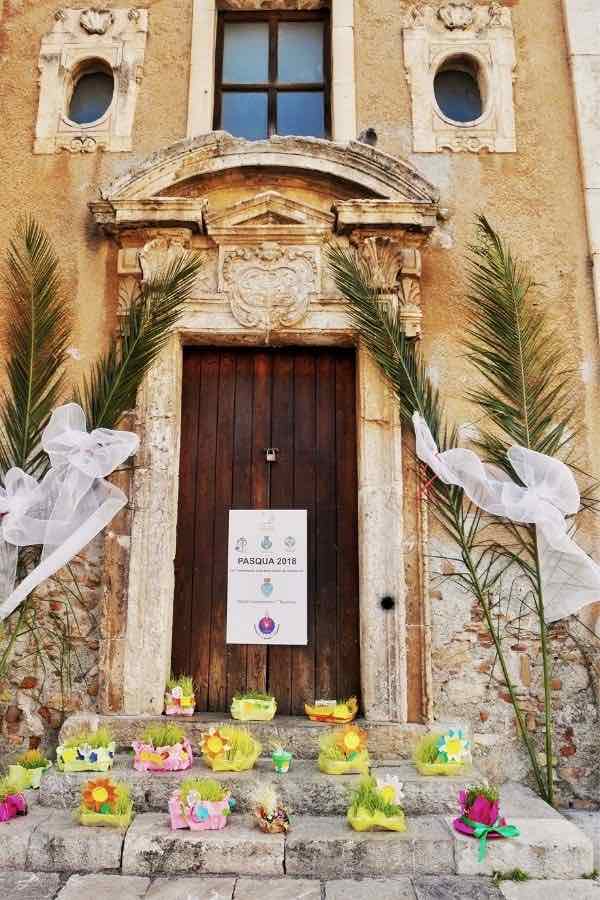
Maundy Thursday (Giovedì Santo) — the Church commemorates the Last Supper. This is the evening of i sepolcri (see below), one of the most atmospheric Easter traditions in Italy.
Good Friday (Venerdì Santo) — the commemoration of the Passion and death of Jesus. On this day, processions are traditional and the Pope walks the Via Crucis (Way of the Cross) in Rome, processing from the Vatican to the Colosseum.
If you are in Rome at this time, I recommend you read our guide to Rome at Easter: it is good to have specific tips (I am from Rome, so I am well equipped to help with this!)
Holy Saturday (Sabato Santo) — a quieter day, with no particular impact on visitors.
Easter Sunday (Pasqua) — a major celebration. The faithful attend Mass in the morning; everyone, religious or not, gathers for a long lunch. Restaurants tend to be fully booked and often offer a set menu, so it is worth reserving ahead.
Easter Monday (Lunedì di Pasquetta) — a public holiday, traditionally spent outdoors with friends (see below).
Religious Italian Easter Traditions
Since Italy has a strong Catholic traditions, it will come as no surprise that many Itaian Easter traditions are attached to the church and its liturgical calendar.
I sepolcri – the sepulchers
This is one of the most fascinating and lesser-known Easter traditions in Italy.
On the evening of Maundy Thursday, after the Messa in Coena Domini, the faithful visit three churches — an act known as fare i sepolcri, or “doing the sepulchres.”

Even for non-religious visitors, it is worth stepping inside a church on this evening, making the most of of the additional opening hours.
Often, you’ll notice altars draped in deep purple, the colour of mourning, and decorated with trays of young wheat.
The wheat has a beautiful symbolic meaning: at the start of Lent, the faithful receive a handful of wheat seeds and are asked to grow them in darkness.
By Holy Week, the blades emerge pale and almost white, having never seen the sun.
This is a deliberate symbol: the darkness represents the tomb, and the living plant represents life winning over darkness.
The Pope’s Via Crucis in Rome
On Good Friday evening, the Pope leads the Way of the Cross through Rome, from the Vatican to the Colosseum.
The event is free and draws enormous crowds, a remarkable thing to witness if you happen to be in the city. The main event in the Colosseum is closed to the public but people gather outside for the celebration.
Easter processions
Across Italy, Good Friday is marked by religious processions through town and village streets, none as big as the Pope’s Via Crucis of course, yet fascinating and worth seeing.
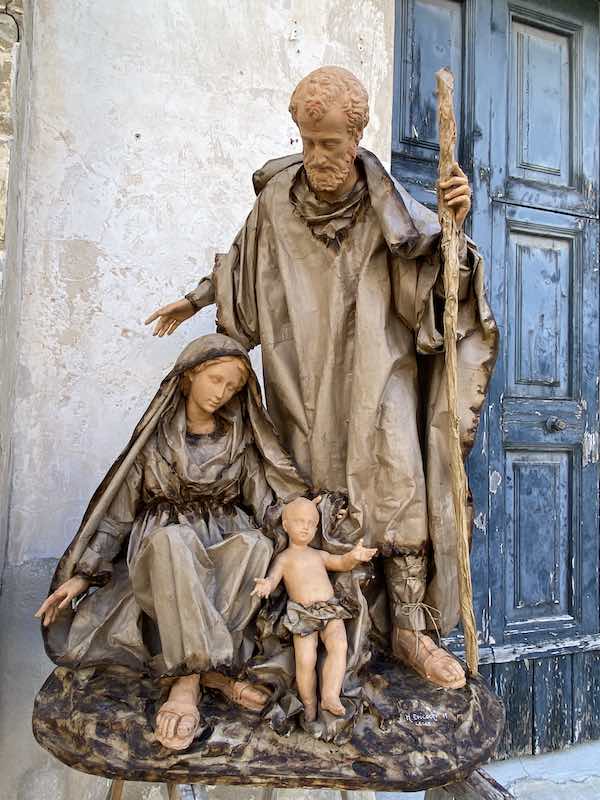
Each has its own local character — costumes, chants, statues carried on decorated platforms — making them feel as much like ancient ritual as religious observance.
They are particularly atmospheric in the south: Puglia, Campania and Sicily all have strong traditions, and the historic towns there make for a spectacular backdrop.
Scoppio del Carro in Florence
Florence has its own unique Easter tradition: the Scoppio del Carro, or “Explosion of the Cart.”
On Easter Sunday, a large ornate chariot packed with fireworks is positioned between the Baptistery and the Cathedral of Santa Maria del Fiore and ceremonially ignited in a spectacular burst of pyrotechnics.
Crowds gather in the piazza to watch from behind barriers: it is a noisy and crowded event but it is unique to the city and can be worth seeing!
No meat on Good Friday
Traditionally, the Church prescribes abstinence from meat on Good Friday or full fasting, as it is still observed on this day by many.
You are not expected to abide by either rule, but it handy to know about them, especially if you are are staying with locals who may observe this.
In practice, for the tourist and the non-religious, this simply means you will find an unusual abundance of fish dishes on restaurant menus that day — a happy consequence, if anything!

Non Religious Italian Easter Traditions in Italy
Chocolate eggs
The Easter egg tradition is not exclusively Italian, but it is wholeheartedly embraced here.
Chocolate eggs are everywhere: small, large, dark, milk, white, with nuts, without, with surprises inside….
If you are visiting Italy at Easter with kids, you will have zero problems finding chocolate eggs for them!
Sugar eggs
As well as chocolate eggs, it is common in Italy to find sugar eggs.
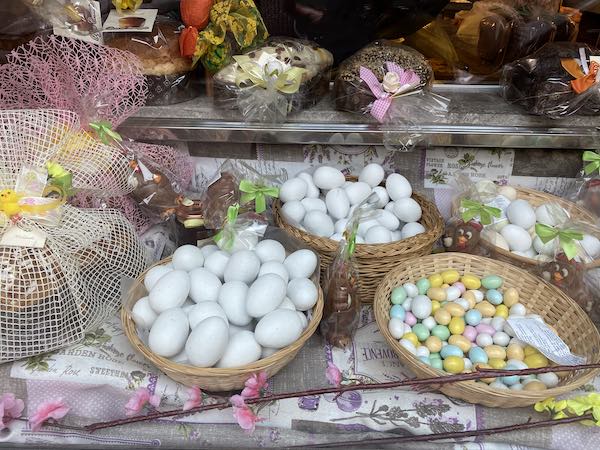
They ave the same size as appearance as real eggs, but the are hollowed inside and make of chocolate covered by a layer of sugar.
Like chocolate eggs, they are super easy to find everywhere and they are super cute as they come in many different colors. Careful with teeth as they can be rather hard at first bite!
Easter Egg Hunts – caccia alle uova
Easter egg hunts are not a traditional Italian custom, but in recent years they have started appearing as organised events, particularly at agriturismi, farm parks, and some historic villas and gardens.
If you are visiting with young children, it is worth searching for events in the area where you will be staying: a simple Google search for caccia alle uova Easter and your destination in the weeks before should turn up anything local. They tend to sell out, so booking ahead is advisable.
La Colomba
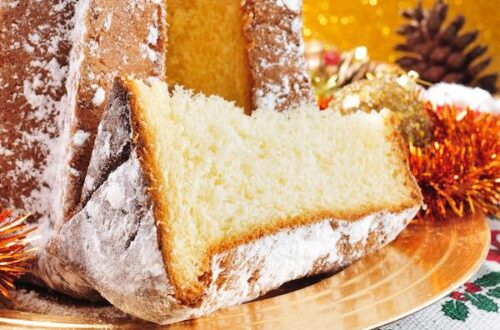
La colomba — “the dove” — is Italy’s traditional Easter cake, the equivalent of panettone at Christmas.
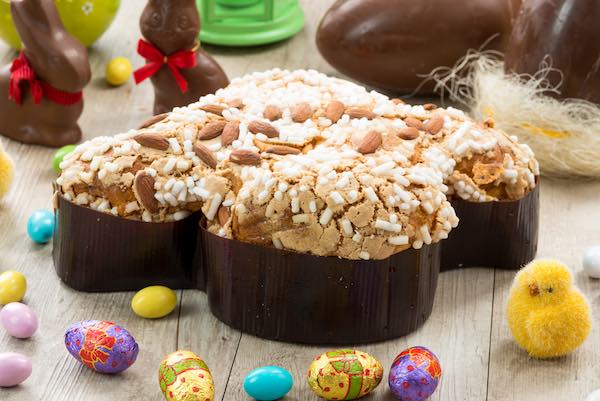
It is a soft, leavened cake topped with a crunchy glaze of sugar and almonds.
You will find it in every supermarket and bakery in the weeks leading up to Easter and it is not, usually, baked at home, not even in the most traditional households.
It is particularly popular among those who observe Lent, as it is often the first sweet they taste after forty days of abstinence (probably, one of the reasons for its popularity, it is not a particularly exciting food, if I can be totally honest!)
La pastiera napoletana
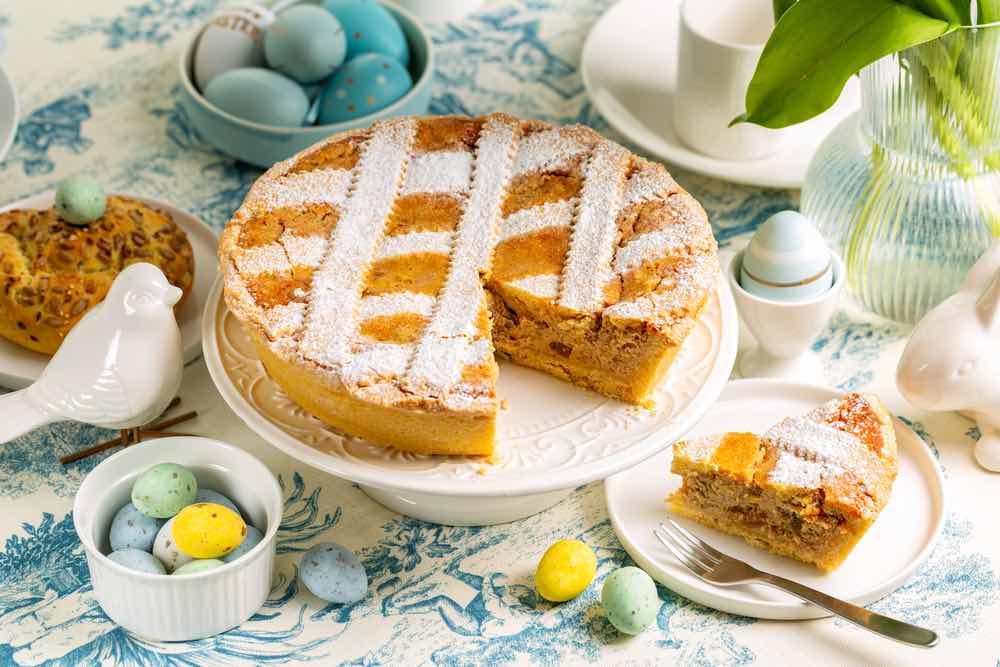
If you find yourself near Naples — or near a good Neapolitan bakery — do not miss pastiera napoletana.
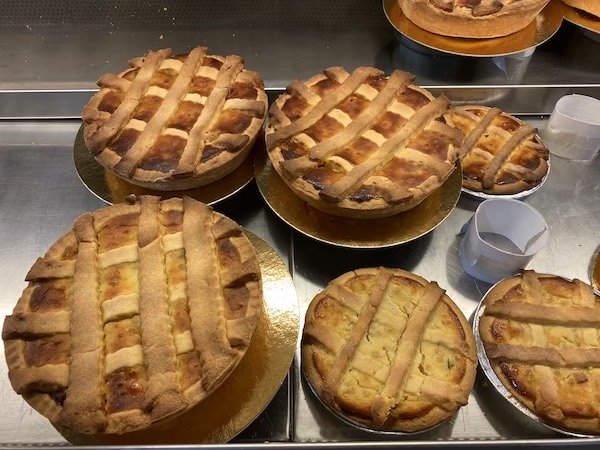
This is a dense, fragrant tart made with cooked wheat, ricotta and orange blossom water, and it is one of those dishes that every Neapolitan will swear their mother makes better than anyone else’s!
It takes time and skill to make well and can be delicious or a little meh if done in a more industrial way. It is worth asking your host if there is a good place for it near you – do not be surprised if not widely available everywhere, this is very much a local food but a very famous and delicious one!
You can find more Italian Easter foods here.
Big Easter Lunch
One of the most deeply rooted Easter traditions in Italy, religious or otherwise, is the long lunch.
Families gather, tables are laid properly, and the meal goes on for hours. The traditional main course is lamb chops — a classic you will find on almost every Easter Sunday menu across the country.
If you plan to eat out on Easter Sunday, book in advance — it is one of the busiest dining days of the year.
Pasquetta day out
Easter Monday (Pasquetta) is a public holiday and Italians traditionally spend it outdoors: a picnic, a barbecue, a day trip into the countryside. It is a lovely, informal counterpart to the more formal Easter Sunday. If you are driving anywhere that day, be aware that roads out of cities tend to be busy in the morning and again in the late afternoon as everyone heads home then.
I hope you enjoyed this overview of Italian Easter traditions and gave you a sense of what to expect and traditions you may want to experience. Buona Pasqua (That’s Happy Easter in Italian!)

Marta Correale
Marta Correale is an Italian mama of two. Born and raised in Rome, Marta has a passion for travel and especially enjoys showing off Italy to her kids, who are growing up to love it as much as she does! A classics graduate from the University of Rome, Marta channeled her passion for culture and travel into the creation of family travel websites that inspire, support and help curious visitors to make the most of a trip to Italy and learn about Italian culture on the way. Marta also manages the thriving online community of parents 'Italy with kids' who turn to her for expert advice and competent Italy travel planning support. She is the author of the travel guides 'Best of Rome with kids' and 'Best of Florence with kids' available on Amazon and of an array of kids printables (scavenger hunts, info booklets etc) available on her Etsy shop 'Mama Loves To Print'