Visiting Italy at Easter: Dates, Crowds, and Everything You Need to Know for a trip you’ll love
All you need to know about Italy at Easter: a travel guide by a local with the best places to see, tops things to do, what to book when and what you need too know to visit Italy at this special time.
Easter is one of my favourite times to be in Italy: the country feels alive in a particular way, with spring in the air, long lunches, chocolate eggs everywhere, and a general sense that everyone has collectively decided to make the most of the long weekend.
That said, it is also one of the busiest times of year, and a little planning goes a long way!
Here is everything you need to know to visit Italy at Easter, from dates and crowds to what to book and where to go.
When is Easter in Italy?
Catholic / Italian Easter falls on a different date each year, anywhere between late March and late April. In 2026, Easter Sunday is on 5th April.
The week leading up to it is called Settimana Santa (Holy Week) and sees several religious celebrations and events, happening in churches on the Sunday, Wednesday, Thursday and Friday before Easter.
However, the holiday stretch Italians care about runs from Good Friday through to Easter Monday (Pasquetta), due to the fact that Easter Monday is National holiday and people make it a four-day weekend.
For planning purposes, the key dates to know each year are:
Palm Sunday — the Sunday before Easter, marks the start of Holy Week.
Good Friday (Venerdì Santo) — two days before Easter Sunday; important religiously and logistically, especially in Rome (see below), although not a national Holiday.
Easter Sunday (Pasqua) — the main event, signifianly affecting tours and attractions opening hours.
Easter Monday (Pasquetta) — a public holiday; Italians traditionally spend it outdoors and traffic can be intense.
All these days come with special events and traditions, most of which can be fun to witness but will not affect your stay. You can read all about Italian Easter traditions here.
How Busy is Italy at Easter?
Honestly? Very.
Easter is one of the peak periods of the Italian tourism calendar, and what makes it particularly intense is that it is not just overseas visitors — Italians travel heavily at this time too. You will see the whole country on the move.
Many families extend it further by taking the full week off, particularly if children are on school holidays — so the busy period often starts from the Monday or Tuesday before Easter and runs through to the Tuesday after at least.
Cities like Rome, Florence, and Venice will be at their absolute busiest.
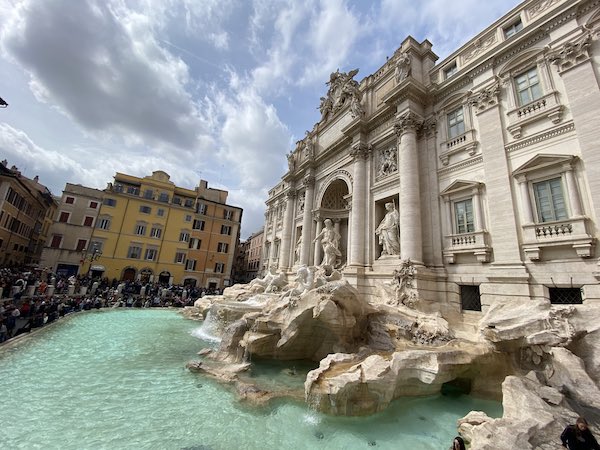
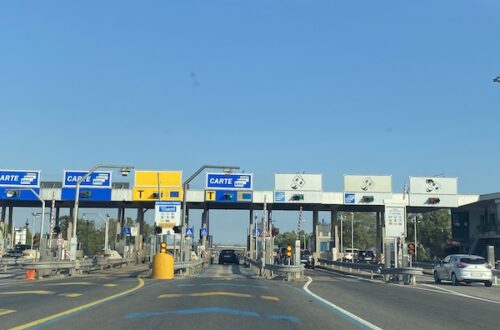
Trains, motorways, restaurants, and popular attractions all feel the pressure. If you are driving anywhere on Easter Monday in particular, budget extra time: roads out of cities fill up in the morning as people head for day trips, and the return traffic in the late afternoon can be significant.
That said, busy does not mean ruined. Italy handles its tourists well, and with a bit of advance planning — especially for bookings — you can have a wonderful trip. I recommend you read my post ‘How to escape crowds in Italy‘ for a realistic ideas.
What to Book in Advance
This is the most important practical section of this post, so I will be direct: book everything as early as you possibly can!
Restaurants for Easter Sunday lunch fill up weeks in advance, and many offer a set menu on the day.
If you have a specific place in mind, do not leave it until the last minute. A few weeks ahead is usually best.
Trains are busy with travelers from all over, especially on the Friday, Monday and Tuesday, so advance booking of those is also a must. A few weeks ahead is usually best
For attractions, the most in-demand sites have their own release windows:
- Vatican Museums — tickets are released several months ahead and sell out fast for Easter
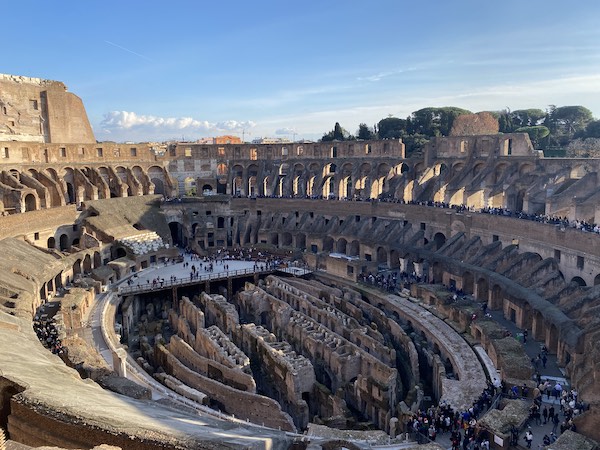
- Colosseum — tickets are released 30 days ahead
- Last Supper (Milan) — tickets are released on a peculiar three monthly schedule you can find here, and last-minute tickets are currently released on the Wednesday of the previous week, but these go almost instantly; book as soon as tickets for your day are released
- Accademia Gallery (Florence) — tickets are released well in advance (often six months or more) and do sell out; book as soon as your travel dates are confirmed
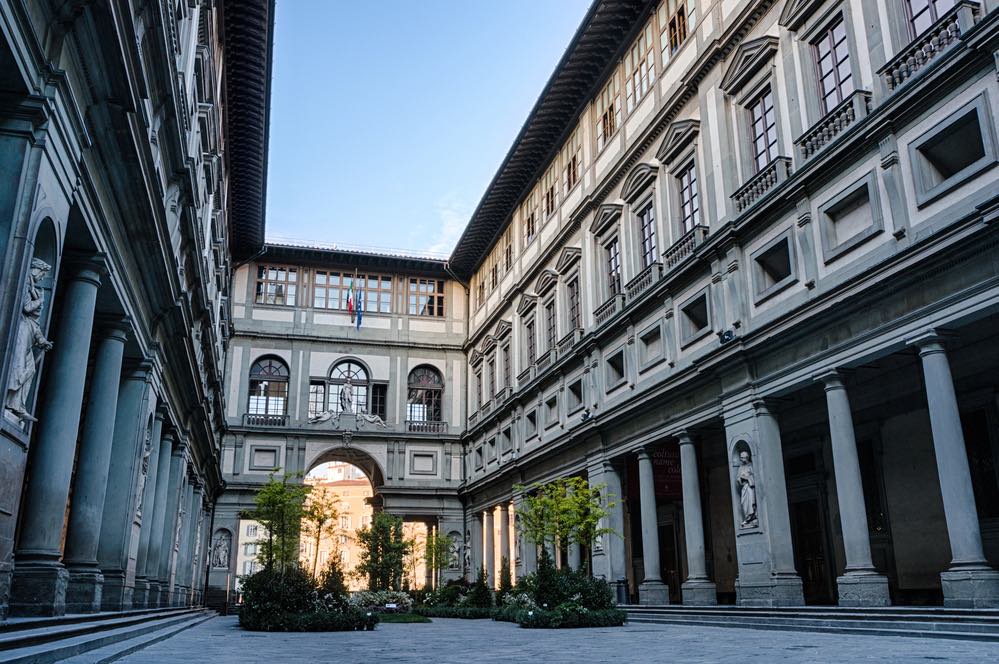
- Uffizi Gallery (Florence) — same as Accademia: book early
You can find my post with ticket resources and what to book when here
One useful tip: tour operators generally have access to different booking channels and can often secure tickets before the official public release windows open. If you are booking very far in advance through a tour operator, always confirm that entry is guaranteed.
Good Friday — A Note for Rome Visitors
Good Friday deserves a specific mention if you are planning to be in Rome, as it has a direct impact on how the day runs.
On Good Friday evening, the Pope leads the Via Crucis — the Way of the Cross — processing from St Peter’s through the city to the Colosseum, where he leads the closing celebrations. This is a colossal event: roads close, security is heavy, and crowds are enormous along the route.
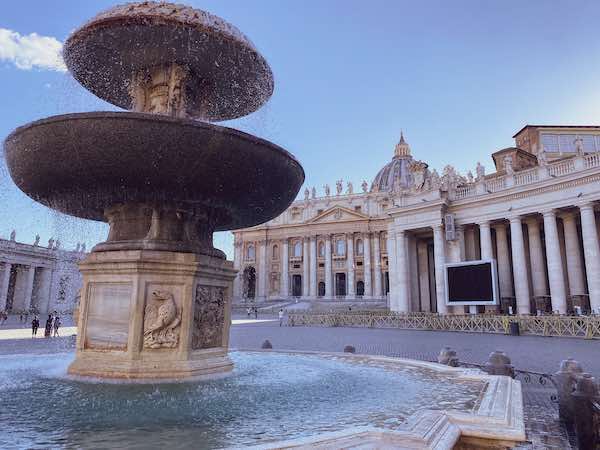
In practical terms, this means the Colosseum typically closes to visitors during the afternoon to prepare for the Pope’s arrival. Access to St Peter’s Basilica may also be affected. I would not recommend planning visits to either site on Good Friday if you can avoid it — security arrangements can lead to last-minute changes, and the disruption is hard to predict precisely.
If you are in Rome and want to witness the Via Crucis, it is genuinely spectacular — free to attend, and the atmosphere along Via dei Fori Imperiali is unlike anything else. Just plan your sightseeing around it rather than alongside it.
If Rome is in your plans, I recommend you read my specific guide about visiting Rome at Easter – I am from Rome and tips from a local really help, in this case!
The Best places to visit in Italy at Easter with Kids
You can visit almost anywhere in Italy at Easter, but with children in tow, I think it is worth being strategic — particularly because the weather in late March and early April is genuinely unpredictable and we know how tolerant kids are of lazy days reading a book with a view – not tolerant at all!.
I know we all picture spring in Italy as blossoms and blue skies and sundresses and sometimes it is exactly that.
But I have been drenched and cold in Sicily, Puglia, Rome, Bologna, Verona, and Trieste, so I would not count on sunshine anywhere. Pack layers, waterproof shoes, and manage expectations with the kids before you go — if the beach day materialises, treat it as a lovely bonus rather than a given.
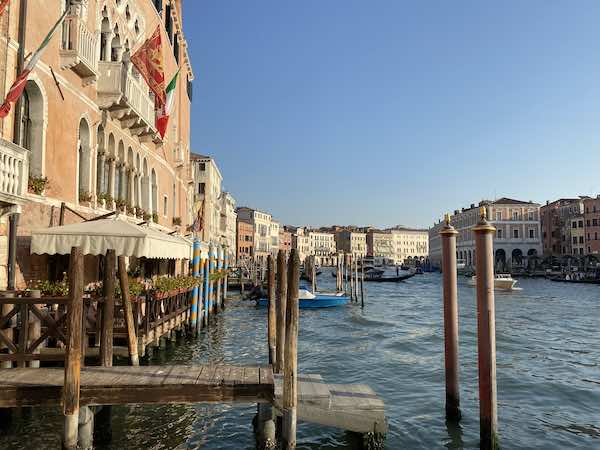
With that in mind, I tend to recommend cities for Easter with kids, simply because they offer the most options when the weather turns. Rome, Florence, Venice, and Turin are all excellent: museums, indoor activities, gelato classes, kid-friendly tours — there is always something to fall back on if the rain sets in.
Rome and Florence are VERY busy at Easter so, it possible, I recommend you avoid the busiest Friday – Monday stretch or, if not possible, you stay a good few days so you can stay in lesser known parts or the city at the busiest times.
Coastal areas like the Cinque Terre and the Amalfi Coast are beautiful at this time, but they are heavily dependent on good weather for their appeal. If you go and it rains solidly, your options become limited quickly. I would only recommend them if you are prepared to be flexible — for instance, hopping on a train to Genoa or Naples if the coast is a washout.
Lesser-visited cities are genuinely worth considering at Easter. You get the festive buzz of the holiday without quite the same intensity of crowds.
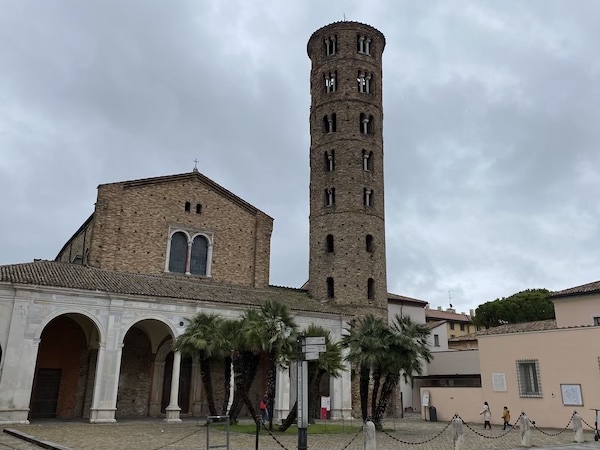
Last year we were in Trieste — absolutely loved it — and we have had wonderful Easters in Ravenna and Verona too. If you have time to get a little off the standard overseas visitor trail, you will find some real gems.
One combination I particularly liked: Rome, Bologna, and Verona back to back. We were rained on for much of the trip, but moving between cities and riding the trains kept the children entertained, and a stop at the Ferrari Museums and Verona’s little tourist train sealed the deal.
Where to Go at Easter Without Kids
If you are travelling as a couple or with adults only, the same general advice applies — cities are reliable, lesser-visited towns are rewarding, and weather is unpredictable — but a few destinations deserve a particular mention at this time of year.
Sicily and Puglia come into their own at Easter for adult travellers.
The religious processions here are among the most atmospheric in Italy: ancient, elaborate, and often running late into the evening.
Towns like Trapani, Marsala, and Taranto take their Holy Week traditions seriously, and simply being there for Good Friday or Maundy Thursday evening is a remarkable experience.
The food and wine at this time of year are also exceptional — spring ingredients, fresh seafood, and a festive energy in the restaurants.

Piedmont is one of my favourite suggestions for a grown-up Easter in Italy.
The Langhe hills in spring are quietly beautiful, the wineries are open, and a long lunch with Barolo in a small osteria is exactly the kind of Easter Monday that dreams are made of.
It does not have the drama of a Sicilian procession, but if what you are after is exceptional food, wine, and a slower pace, it is hard to beat.

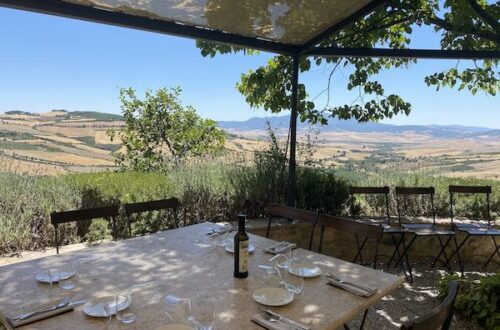
Tuscany follows similar logic — the countryside around Siena, Montalcino, and Montepulciano is lovely in spring, and the combination of wine estates, hilltop towns, and good restaurants makes for a very happy long weekend.
In general, the places that are slightly less practical with children — those that rely on slow wandering, late evenings, and lingering over food and wine — tend to be the ones that reward adult visitors most at this time of year.
What to Do with Kids at Easter
Beyond sightseeing, Easter in Italy has a few things that children specifically tend to love.
Chocolate eggs are everywhere from several weeks before Easter — in every supermarket, bakery, and souvenir shop, in every size and variety imaginable. The traditional kind are large hollow eggs made of plain or milk chocolate with a surprise inside; you can also find ones with a sugar coating that looks exactly like a real eggshell, which children tend to find delightful.
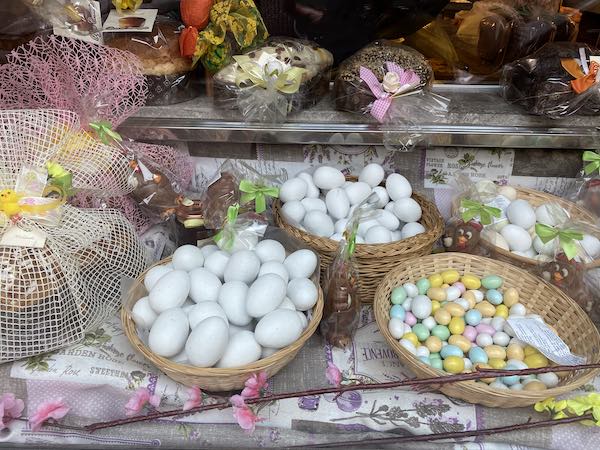
Easter egg hunts (caccia alle uova) are not a traditional Italian custom, but they are becoming increasingly popular as a borrowed tradition — a bit like Halloween has taken hold in recent years. Agriturismi, farm parks, and some historic villas and gardens now organise Easter egg hunt events, and they can be a lovely activity for younger children. Search for caccia alle uova plus your destination in the weeks before Easter to find anything local, and book ahead as they tend to sell out.
For indoor activities — which, as I said, are worth having up your sleeve regardless of the weather — I particularly like cooking and gelato classes, car museums (the Ferrari and Lamborghini museums are brilliant for kids), and interactive museums like the Leonardo da Vinci museums or the various Museo delle Illusioni locations around the country.
What to Eat at Easter in Italy
Easter food in Italy is worth a post of its own (and I have written one here!) but briefly, three things I recommend seeking out:
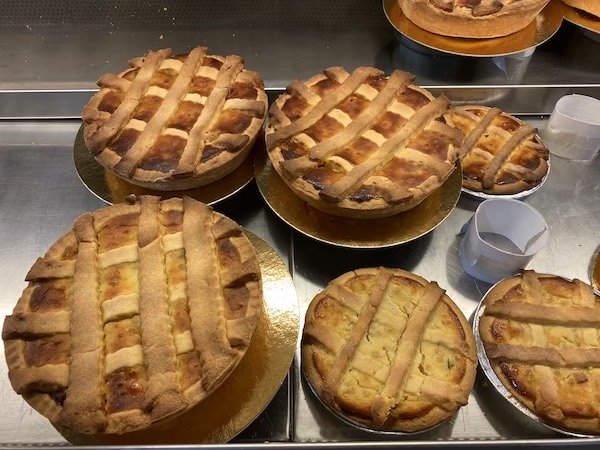
Pastiera Napoletana — a dense, fragrant tart from the Naples tradition, made with cooked wheat, ricotta and orange blossom water. It takes real skill to make well, and when it is good, it is exceptional. The best I have ever had was from Sal de Riso, a patisserie originally from the Amalfi Coast but now with nationwide fame. Seek out an artisan version if you can.
Colomba Pasquale — Italy’s Easter cake, the equivalent of panettone at Christmas: a soft, leavened cake topped with almonds and a crunchy sugar glaze. It is not the most exciting thing you will ever eat, but it is genuinely good and so tied to this time of year that it feels like a must.
Torta Pasqualina — a savoury pie made with pastry, ricotta, spinach and a whole egg baked inside. This one you are more likely to encounter at a home lunch or an agriturismo than in a restaurant, but it is worth trying if you get the chance. I have a recipe on the site if you want to make it yourself!
Packing for Italy at Easter
I have said it above but it bears repeating: do not pack for summer. March and April in Italy can be genuinely cold and wet, and I have the soggy shoes to prove it.
My packing recommendations for Easter in Italy:
- Layers are essential: t-shirts, hoodies, a proper jacket
- Long trousers/jeans as well as shorts if your kids run warm
- Scarves if you are travelling earlier in the month or if your family is used to a warm climate
- Waterproof shoes or two pairs of trainers, so you can rotate when one pair gets soaked
The goal is to be comfortable in 10 degrees and rain, and pleasantly surprised if you end up in 20 degrees and sunshine.
I hope this helps you plan a wonderful Easter in Italy!

Marta Correale
Marta Correale is an Italian mama of two. Born and raised in Rome, Marta has a passion for travel and especially enjoys showing off Italy to her kids, who are growing up to love it as much as she does! A classics graduate from the University of Rome, Marta channeled her passion for culture and travel into the creation of family travel websites that inspire, support and help curious visitors to make the most of a trip to Italy and learn about Italian culture on the way. Marta also manages the thriving online community of parents 'Italy with kids' who turn to her for expert advice and competent Italy travel planning support. She is the author of the travel guides 'Best of Rome with kids' and 'Best of Florence with kids' available on Amazon and of an array of kids printables (scavenger hunts, info booklets etc) available on her Etsy shop 'Mama Loves To Print'